On this page
Computers use binary because their hardware is built from switches, and a switch is the cheapest reliable component electronics offers: it only ever has to answer one question — is there voltage here, or not? Two widely separated voltage bands give circuits a large error budget called the noise margin, two states map perfectly onto Boolean logic, and eighty years of compounding investment have made the binary ecosystem unbeatable. The interesting part is that none of this was mathematically inevitable — decimal and even ternary machines were genuinely built and sold. Below: the physics, the history from Boole to von Neumann, the alternatives that lost, and why even today's multi-level flash memory and quantum computers still show a binary face to the world.
What you'll learn:
- ✓ Why two voltage states beat ten — the noise-margin math in datasheet numbers
- ✓ How Boolean logic turned two-state switches into full computers
- ✓ The decimal and ternary machines that genuinely competed — and why they lost
- ✓ Where modern hardware secretly uses 4 or 16 levels, and the price it pays
- ✓ Whether quantum computing changes any of this (short answer: no)
- ✓ A copy-paste “Hello” in binary you can test in any converter
The Short Answer
Why do computers use binary? Four reinforcing reasons, none of them alone decisive, together overwhelming:
- Physics — relays, vacuum tubes and transistors are natural two-state devices. Building ten precise, stable states is hard; building two is almost free.
- Reliability — two wide voltage bands tolerate noise, heat and aging that would destroy a ten-level signal.
- Logic — the same signal that means 1 or 0 also means true or false, so arithmetic and decision-making share one machinery: Boolean algebra.
- Economics — every design tool, chip fab, memory technology and trained engineer on Earth is optimized for two levels. Any challenger fights that entire ecosystem.
It Starts With the Switch
Every practical digital computer is made of elements that behave as on/off switches. A relay is open or closed; a vacuum tube passes current or does not; a modern transistor in a CMOS gate is driven fully conducting or fully cut off. John von Neumann saw the consequence clearly in 1945, writing in the EDVAC report that the vacuum tube used as a gate is an all-or-none device, that the simplest trigger circuits have exactly two stable equilibria, and that circuits with more than two equilibria are disproportionately more involved. His conclusion was direct: a machine whose components are two-valued should use arithmetic whose digits are also two-valued.
The scale of modern chips makes the choice self-reinforcing. Apple's M4 Ultra packs roughly 72 billion transistors and NVIDIA's B200 GPU about 208 billion — every one engineered to snap decisively between two states, billions of times per second. The whole manufacturing stack, from doping profiles to design software, assumes exactly two logic levels.
Two Wide Voltage Bands Beat Ten Precise Levels
A 1 and a 0 are not exact voltages — they are wide bands of voltages. In a classic 5 V logic family, anything above roughly 2 V reads as high and anything below 0.8 V reads as low, with a generous no-man's-land in between. A standard textbook puts the reason plainly: a high voltage indicates a 1 and a low voltage indicates a 0 because it is easier to distinguish between two voltages than ten.
Do the arithmetic for a decimal electronic digit. Ten levels inside a 5 V window leave about 0.5 V between adjacent levels before any safety margin is reserved — and once you subtract the tolerances every real component needs, the usable margin per level shrinks to tens of millivolts. One decimal digit also carries only log₂10 ≈ 3.32 bits of information: a modern designer would rather spend four cheap, robust binary cells than one precision ten-state device to hold the same content.
Noise Margins: Binary's Error Budget
The decisive engineering argument for binary is the noise margin: the gap between the worst-case voltage an output guarantees and the worst-case voltage an input still accepts. Real signals degrade — resistance, capacitive coupling, supply ripple and heat all eat into them — so that gap is the circuit's error budget. Datasheet limits for classic 5 V TTL give margins of 0.7 V (high) and 0.3 V (low); 5 V CMOS improves on that with 1.4 V and 0.9 V, one reason CMOS displaced TTL.
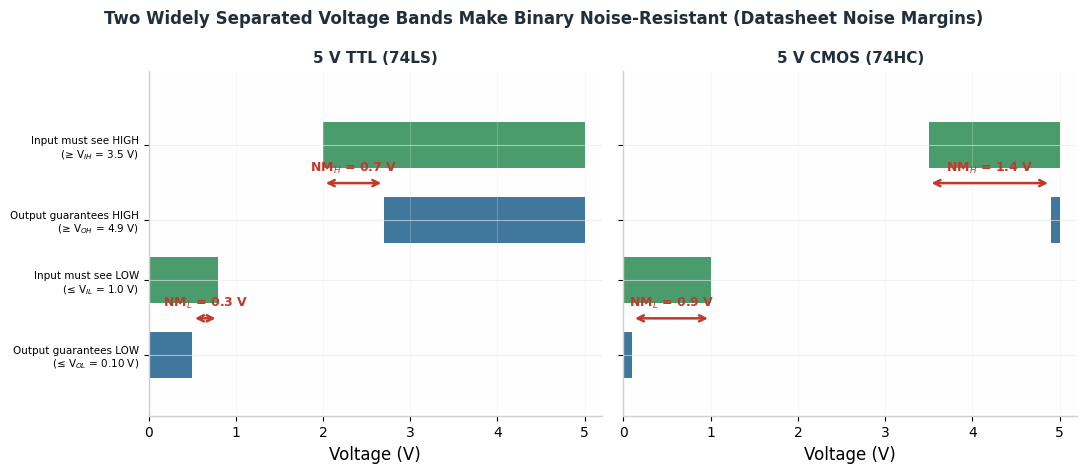
Binary gets a second, subtler benefit: regeneration. Every gate in a chain re-decides between the two legal levels and outputs a fresh, full-swing signal, so noise never accumulates through the machine. A ten-level gate would have to resolve nine internal thresholds accurately at every stage — a precision-analog problem repeated on every one of billions of transistors.
Power, Heat and the V² Problem
In CMOS — the technology behind essentially all modern logic — dynamic power is proportional to the square of the supply voltage. Multi-level logic forces a bad trade: either spread more levels across the same voltage swing (destroying noise margins) or raise the supply voltage (paying the V² penalty in power and heat). The industry ran the other way, dropping supplies from 5 V through 3.3 V to around 1 V. Heat was a binding constraint from the very start: ENIAC's roughly 18,000 vacuum tubes drew about 150 kW and demanded dedicated power lines and forced-air cooling.
Boolean Logic Comes Free
The deepest convenience of base 2 is a coincidence: the same signal can represent a number (1 or 0) or a truth value (true or false). That means arithmetic and decision-making — addition, comparison, branching, address decoding — are all built from the same primitive gates: AND, OR, NOT. Computing is mostly deciding, not calculating, and a machine whose digits are truth values needs no translation layer between the two. Multi-valued logics exist, but none enjoys the algebraic simplicity and the century and a half of development behind two-valued Boolean logic.
A Short History: Boole, Shannon and the EDVAC Report
The logical foundation predates electronics by almost a century. Leibniz published a complete account of base-2 arithmetic in 1703, though he never recommended it for daily calculation. George Boole's Mathematical Analysis of Logic (1847) and Laws of Thought (1854) built an algebra on the law x² = x — an equation with exactly two solutions, 0 and 1 — and for eighty years it gathered dust as pure philosophy.
In 1937, a 21-year-old MIT master's student, Claude Shannon, recognized that Boole's true/false values map exactly onto the open/closed states of relay contacts: switches in series implement AND, in parallel OR, an inverted contact NOT. Any circuit could be written as algebra, and any algebraic expression could be built as a circuit — so circuits could be simplified and verified on paper instead of by trial and error. The thesis, historian Herman Goldstine later wrote, helped change digital circuit design from an art to a science. Whatever two-state device an engineer could build now came with a complete design method for free.
Then, on June 30, 1945, von Neumann's EDVAC report laid out the stored-program computer and argued explicitly for binary: tubes are all-or-none, so the machine should store binary material only, with decimal conversion confined to the input and output organs where humans need it. Nearly every machine that followed — EDVAC, BINAC (the name literally means Binary Automatic Computer), EDSAC — adopted the template, and native decimal electronics was effectively finished within a decade.
ENIAC: The Decimal Giant That Proved the Rule
The first general-purpose electronic computer was, strikingly, decimal. ENIAC, completed in 1945, stored each decimal digit in a ten-position ring counter — ten elements of which only one is ever active. The machine filled a 30-by-50-foot room, weighed 30 tons, consumed about 150 kW and performed roughly 5,000 additions per second. Revolutionary — but each digit cost ten times the elements a bit costs, and programming meant physically rewiring plugboards. Tellingly, ENIAC's individual tubes already operated as binary switches; the decimal organization lived at the architectural level, paid for with a tenfold redundancy its own designers abandoned in the follow-on machine.
The Alternatives That Were Tried
Decimal computing had a real commercial career after ENIAC. The IBM 650, shipped from 1954, became the first mass-produced computer with about 2,000 units built. It stored decimal digits in a bi-quinary code using 7 bits per digit — of which only 10 of the 128 possible codes were valid, deliberate redundancy that bought hardware error checking at under 50% storage efficiency. Binary-coded decimal never fully died: it survives in calculators, digital clocks and financial software where exact decimal rounding is legally required — and you can experiment with it in our BCD converter. But note what BCD proves: the industry kept decimal semantics where humans demand them, implemented over binary hardware.
The most serious hardware alternative was base 3. In 1958, Nikolay Brusentsov's team at Moscow State University built Setun, a balanced-ternary computer whose digits are −1, 0 and +1. Balanced ternary has real elegance: negation is just flipping every digit's sign, truncation coincides with correct rounding, and there is no signed/unsigned distinction. Donald Knuth called it perhaps the prettiest number system of all. Setun passed official testing with unusual reliability and reportedly cost far less than binary contemporaries — yet only about 50 were built before Soviet industry halted production in 1965 in favor of a binary machine of equal performance at 2.5 times the price.
Why Binary Beat Ternary
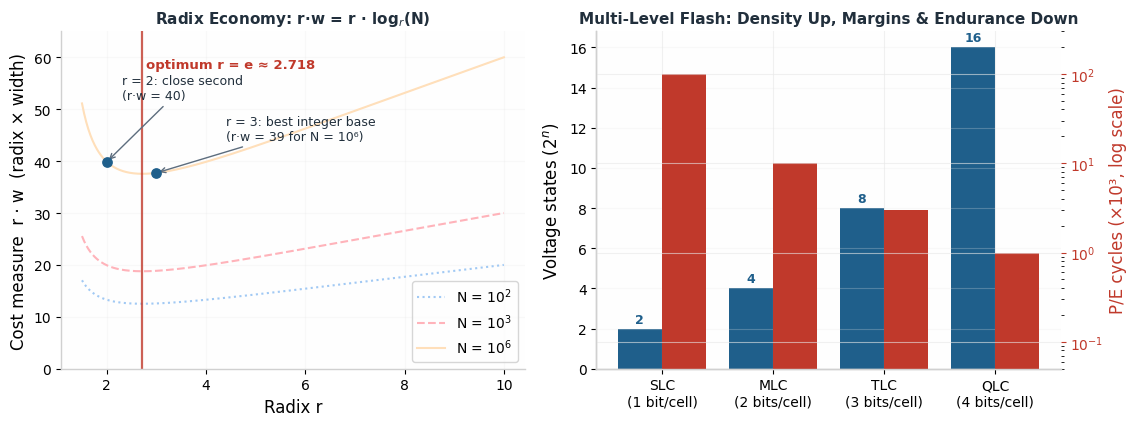
The theoretical case against binary is real. If the cost of representing numbers up to N is modeled as radix times digit count, the optimum is base e ≈ 2.718 — making 3 the most economical integer base: for N = 1,000,000 the cost measure is 60 for decimal, 40 for binary and 39 for ternary. Brian Hayes's classic American Scientist essay “Third Base” walks through why the model still fails in practice: it assumes a digit costs the same regardless of radix, and that is false. A reliable two-state device is drastically cheaper, faster and lower-power than a reliable three-state device — even Setun stored each trit in a pair of cores that could have held two bits, squandering the theoretical advantage.
Once binary components became the mass-produced standard, network effects did the rest: design tools, fabrication processes, memory technologies, software and trained engineers all compounded around base 2. As analysts of the Setun story put it, network effects — not physics — killed ternary computing in the 1960s.
The whole contest, from mechanical decimal to quantum, fits in one table:
| System | States per Digit | Era | Key Numbers | Outcome |
|---|---|---|---|---|
| ENIAC | 10 (ring counters) | 1945 | ~18,000 tubes, ~150 kW, ~5,000 adds/s | Proved electronic computing; ten elements per digit made decimal uneconomical |
| EDVAC design | 2 | 1945 report | Stored-program template | Set the pattern nearly all later machines followed |
| IBM 650 | 10 (bi-quinary, 7 bits/digit) | 1953–1962 | ~2,000 units sold | Decimal survived for business I/O at under 50% storage efficiency |
| Setun | 3 (balanced −1, 0, +1) | 1958–1965 | ~50 units built | Elegant arithmetic, but the binary ecosystem prevailed |
| TTL / CMOS logic | 2 | 1960s–today | Noise margins 0.7/0.3 V (TTL), 1.4/0.9 V (CMOS) | Maximum error budget per volt of supply — the incumbent |
| QLC flash | 16 (4 bits/cell) | 2010s–today | ~100–1,000 write cycles; ~100–200 mV level gaps | Multi-level only behind heavy error correction; binary interface kept |
| PCIe 6.0 PAM-4 | 4 (2 bits/symbol) | 2022–today | Published 64 GT/s; mandatory error correction | Multi-level accepted only where channel physics forces it |
| Quantum (qubit) | 2 basis states + superposition | 2000s–today | Physical error ~10⁻³–10⁻⁴ vs classical under ~10⁻¹⁷ | Two-state quantum systems, steered by binary classical computers |
Bottom line: every attempt to leave base 2 either retreated within about a decade (decimal, ternary) or survives only wrapped in enough error correction to present a binary interface to the rest of the system (flash, PAM-4, qubits). Two widely separated states remain the cheapest reliable abstraction in computing — which is the whole answer to why computers use binary.
See binary do its job
Type any word into our text to binary converter and watch every letter become an 8-bit byte — the two-state system from this article, working live in your browser.
Open the text to binary converterModern Exceptions: Multi-Level Flash and PAM-4
Modern hardware does venture beyond two levels — and the exceptions prove the rule. NAND flash stores charge in a cell at more than two threshold levels: SLC holds 1 bit in 2 states, MLC 2 bits in 4, TLC 3 bits in 8, QLC 4 bits in 16. The reliability cost follows the noise-margin logic exactly: typical write endurance falls from roughly 50,000–100,000 cycles for SLC to just 100–1,000 for QLC, whose 16 levels sit only about 100–200 mV apart. QLC works at all only behind strong error-correcting codes and controller read-retry — the multi-level medium is wrapped in enough binary-coded redundancy to present a reliable binary interface to everything above it.
The same pattern appears in high-speed links: PCIe 6.0 abandoned two-level signaling for PAM-4 (four levels, 2 bits per symbol) to hit a published 64 GT/s, accepting a threefold reduction in signal eye height and mandatory forward error correction. Engineers leave base 2 only where physics offers no cheaper option — and each time they pay a steep error-correction tax to defend the binary layer on top.
What About Quantum Computers?
Quantum computers genuinely transcend the classical bit: a qubit exists in a superposition of two basis states and collapses to 0 or 1 when measured. Yet notice the structure — the basis is still two states, because two well-separated, controllable energy states are what nature and engineering most readily provide. And the reliability gap dramatizes the classical lesson: transistor gates err at rates below 10⁻¹⁷ per operation, while today's best physical qubits err at roughly 10⁻³ to 10⁻⁴, forcing each logical qubit to be encoded in thousands of physical ones. Binary classical computers do all of the control, compilation and error decoding. Quantum machines complement binary computing for specific problems; they do not replace it.
What This Means in Practice
Why should anyone who is not designing chips care why computers use binary? Because it explains the shape of everything you meet in computing. It is why text arrives in 8-bit bytes, why 01001000 01101001 decodes cleanly to “Hi” (try it in the binary code translator), and why a string of bits can be a number or text depending on context. It is why programmers read raw binary as hexadecimal shorthand — see binary vs hexadecimal — and why flags and bitmasks work the way they do. Understanding that 0 and 1 are voltage bands, not magic digits, turns the whole stack from mystery into engineering. For the foundations, start with what binary code is and how binary numbers work, or convert values directly with the binary to decimal converter.
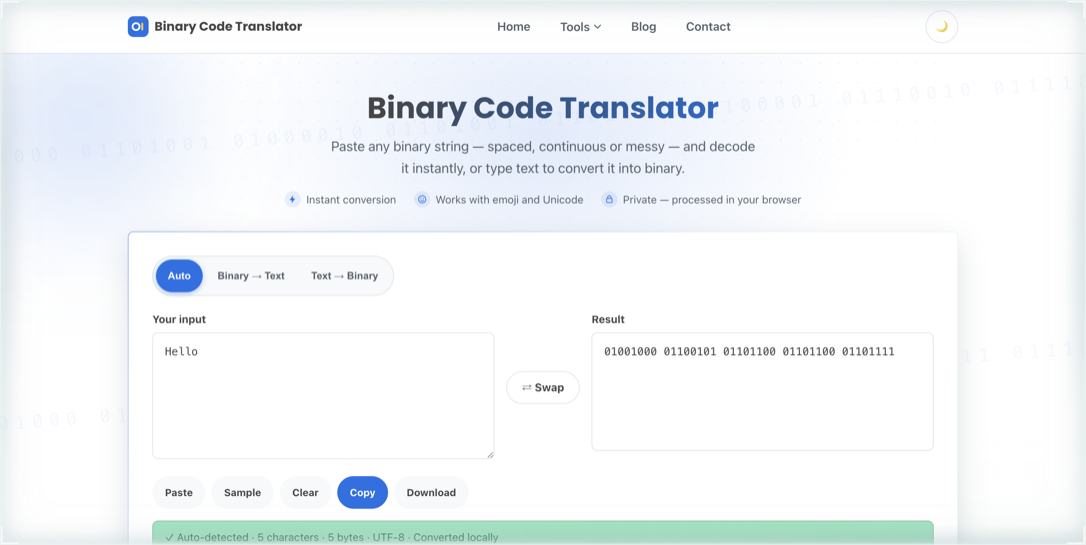
That screenshot is no trick — the mapping is public and repeatable. Each letter is one ASCII number, and each number is one byte:
| Letter | ASCII (decimal) | Binary byte |
|---|---|---|
| H | 72 | 01001000 |
| e | 101 | 01100101 |
| l | 108 | 01101100 |
| l | 108 | 01101100 |
| o | 111 | 01101111 |
Join the five bytes and you get the full string — copy it, paste it into any binary-to-text tool (including ours), and it decodes straight back to “Hello”:
01001000 01100101 01101100 01101100 01101111
Common Misconceptions About Binary
- “Binary is mathematically the best base.” It is not — radix economy favors base 3. Binary is the best engineering compromise: the smallest radix that supports positional arithmetic, hence the most noise-tolerant and cheapest to manufacture.
- “Computers think in 1s and 0s.” Hardware moves voltages. We interpret wide high and low bands as 1 and 0; the binary is a description layered on the physics.
- “Decimal computers never existed.” ENIAC was decimal, the IBM 650 sold about 2,000 units, and BCD arithmetic still runs in calculators and financial software today.
- “Quantum computing will end binary.” Qubits use two basis states, need massive error correction, and are entirely controlled by binary classical computers.
- “Binary was chosen for humans.” Why binary code rather than something readable? Because the notation serves the machine; humans get decimal conversion at the edges, exactly as von Neumann prescribed in 1945.
Frequently Asked Questions
Why do computers use binary instead of decimal?
Because a switch only has to tell two states apart. Ten voltage levels inside the same supply window would shrink the error budget per level to a fraction of a volt, making circuits slower, hotter and far more error-prone than two widely separated bands.
Is binary the most efficient number system possible?
Not in theory. Radix-economy math — radix times digit count — favors base 3, with base 2 a close second. But the model assumes every digit costs the same to build, and a reliable three-state device costs far more than a reliable two-state switch, so binary wins in practice.
Did anyone ever build a non-binary computer?
Yes. ENIAC (1945) was decimal, the IBM 650 sold about 2,000 decimal machines in the 1950s, and the Soviet Setun (1958) was a balanced-ternary computer with roughly 50 units built. All were eventually displaced by cheaper binary hardware.
Do computers literally think in 1s and 0s?
No — hardware moves voltages, not digits. Engineers interpret a high voltage band as 1 and a low band as 0. Binary is the description we put on the physics, not a substance flowing inside the chip.
Why binary code and not something easier for humans to read?
Because the notation serves the hardware, not the reader. Humans get decimal conversion at the input and output boundary — exactly the split von Neumann proposed in 1945 — while hex and tools like translators make raw binary readable when people genuinely need it.
Is everything in a modern computer really binary?
Logically yes, physically not always. QLC flash stores 16 voltage levels per cell and PCIe 6.0 sends four-level signals — but both hide behind heavy error correction and present a binary interface to the rest of the system.
Will quantum computers replace binary?
No. A qubit is a superposition of two basis states, and binary classical computers handle the control, compilation and error decoding of every quantum machine. Quantum hardware complements binary computers for specific problems rather than replacing them.
Who decided that computers should use binary?
No single person, but John von Neumann's 1945 EDVAC report made the explicit case: vacuum tubes are all-or-none devices, so two-valued digits are the natural arithmetic. Nearly every computer built since has followed that template.
What does Boolean logic have to do with binary?
Claude Shannon proved in 1937 that Boolean algebra maps exactly onto switching circuits: switches in series implement AND, in parallel OR, and an inverted contact NOT. A two-state machine inherits a complete, rigorous design method for free.
Can a binary translator decode any string of 0s and 1s?
No — and ours will say so instead of guessing. Text only exists in complete 8-bit bytes, so a fragment like 10101 is not a broken letter; it is the number 21 or a corrupted paste. No converter can recover a message that was never encoded as text bytes in the first place.
Turn the theory into bytes
✓ Free and unlimited · ✓ converted locally in your browser · ✓ auto-detects the direction. Paste any word into the binary code translator and watch it become 8-bit bytes — the two-state machinery from this article, doing its everyday job.
Open the binary code translatorPrefer pencil and paper? The fallback works offline: our four-step hand method converts text to binary with nothing but place values — ✓ no tools needed · ✓ works anywhere · ✓ doubles as practice.